When the heating cuts out on a cold night, most people just want someone to turn up and fix it. That’s where the confusion starts. Home emergency cover UK and boiler cover can look similar on the surface, because both often come with a helpline and an engineer call-out. The difference matters when the problem isn’t just the boiler, like a burst pipe soaking your kitchen, or an electrical fault that makes your home unsafe.
This guide compares what each cover is, what’s usually included and excluded, and the limits that trip people up (call-outs, excess, repair caps, and waiting periods).
Boiler cover is a service plan focused on your boiler and heating system. Home emergency cover is a wider policy that helps with urgent household faults (often including plumbing, electrics, and home security).
Home emergency cover vs boiler cover, what they are and where you buy them
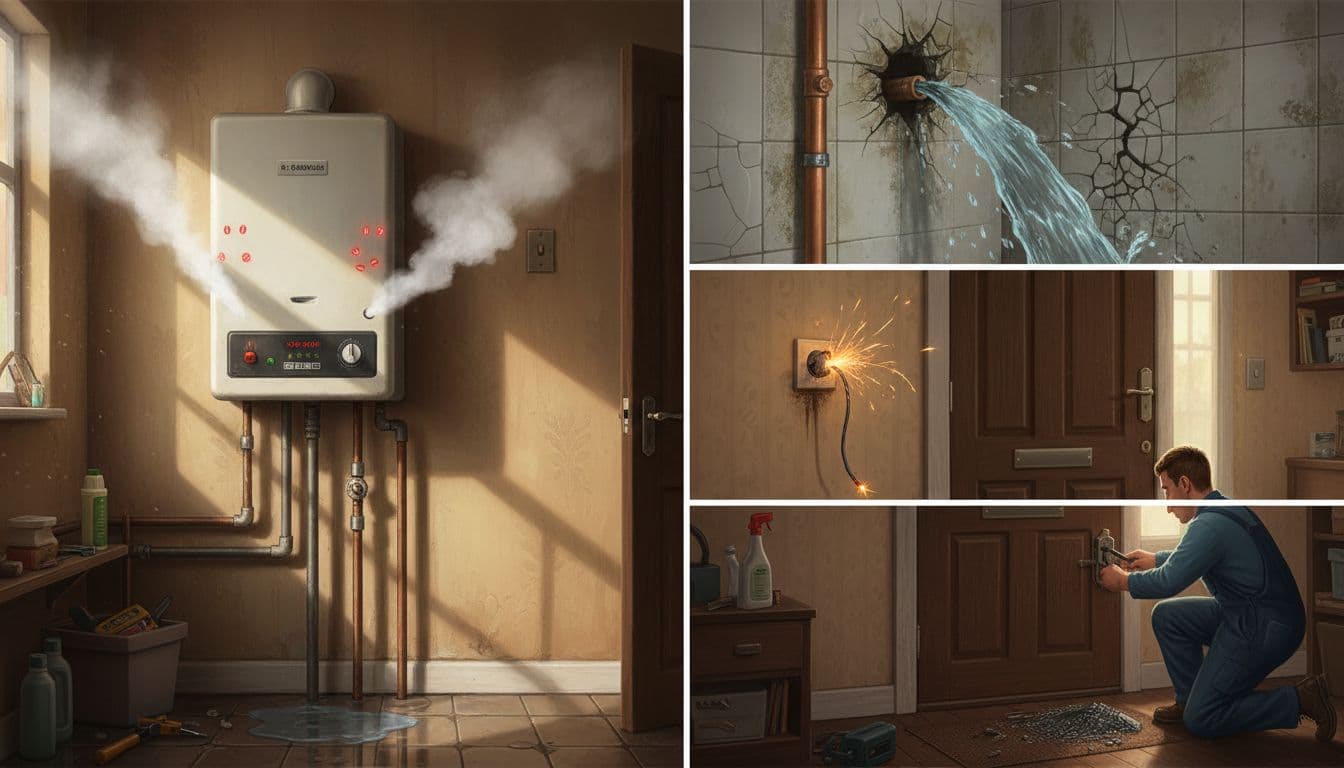 Split scene showing a boiler fault alongside common household emergencies, created with AI.
Home emergency cover is usually sold as an add-on to buildings and contents insurance, although you can also buy it as a standalone policy. It’s designed to get urgent problems dealt with fast, by sending an approved tradesperson to your home. Think of it like an emergency call-out service wrapped into insurance, with a set limit per incident.
Boiler cover is usually bought as a standalone monthly or annual plan. Some policies are boiler-only, while others include the wider heating system (radiators, controls, pumps) and may include an annual service as part of the package or as an optional extra.
Both types often include:
- A 24/7 claims line (or out-of-hours support)
- An engineer or tradesperson call-out
- Parts and labour up to a limit
The key difference is scope. Home emergency cover is about a range of household emergencies. Boiler cover is about keeping your heating working.
It also helps to think of both as service-style policies, not a promise to fix every issue in your home. They come with limits, definitions, and exclusions. If the repair is complex, the part is rare, or the issue is classed as maintenance, you may still pay.
What counts as an “emergency” and why this affects claims
An “emergency” usually means the fault creates a real risk, like danger to health and safety, or major damage to the home. A serious water leak, total power failure, or an insecure external door often fits that definition.
Some heating problems are treated differently depending on the risk. No heating in winter can be urgent, but a minor fault that still leaves you with hot water might not get the same response. A smell of gas or signs of carbon monoxide risk is a different category again, and may require you to contact the emergency gas service rather than an insurer.
How boiler cover overlaps with home emergency cover (and with your home insurance)
Overlap is common. A boiler breakdown might be covered by boiler cover, and also by home emergency cover if your emergency policy includes heating. Water leaks are another crossover point.
Also check what your main home insurance already does. Buildings insurance often covers escape of water damage (like ruined plaster and flooring), but it doesn’t usually pay for the urgent call-out to stop the leak right now. Home emergency cover is often aimed at that immediate response, while buildings insurance deals with the bigger repair and reinstatement afterwards.
What’s included and what’s not, a simple side by side comparison you can use
 Emergency plumbing call-out in a UK kitchen, created with AI.
| Feature | Boiler cover (UK) | Home emergency cover UK |
|---|---|---|
| Typically included | Boiler breakdown repairs, often heating controls, radiators, pumps, valves | Plumbing and drainage, electrics, home security, sometimes heating and boiler, sometimes roof leaks or glazing (limited) |
| Typically excluded | Pre-existing faults, poor install, sludge/limescale issues, upgrades, non-heating plumbing | Maintenance, wear and tear, slow leaks, cosmetic fixes, non-urgent issues, some communal/shared systems |
| Call-out or attendance limits | Often “unlimited” repairs, but fair use rules may apply | Often unlimited call-outs, but each incident has a repair cap |
| Repair vs replacement | Repair-focused, replacement may be limited by age/eligibility and parts availability | Usually repair or “make safe”, replacement is uncommon and capped |
| Parts and labour limits | Often included, but may have limits for access and “making good” | Included up to a set amount per emergency, commonly around £500 per incident |
| Excess | Often a fee per claim (commonly £50 to £100), some offer no-excess options | Often no excess, but some policies charge a call-out fee or apply an excess |
| Waiting periods | Common, often 14 days to a month | Common, sometimes 48 hours to 7 days |
| Annual claim limits | Some plans have overall caps or “reasonable use” wording | May have an annual cap, or rely on per-incident caps instead |
| Response times | Emergency or priority attendance, can be same or next day, slower in peak winter | 24/7 helpline, attendance targets vary by fault severity and location |
The biggest difference is that boiler cover tends to go deeper on heating faults, while home emergency cover tends to go wider across your home. Another key point is the repair cap. If your emergency policy caps each job, a costly repair can spill over into your own pocket.
Home emergency cover, what’s commonly included (and what is often excluded)
Most home emergency cover focuses on urgent faults in the systems you rely on every day:
Often included
- Boiler breakdown and central heating (only if your policy includes heating)
- Plumbing and drainage, burst pipes, major leaks, blocked drains
- Electrics, total power failure, unsafe wiring issues
- Roof leaks, often a temporary repair to stop water coming in
- Home security, broken external locks, lost keys, damaged doors (make-safe work)
- Glazing, sometimes limited to essential windows or doors
- Water leaks, where urgent action prevents major damage
Often excluded
- Slow drips and long-term damp
- General wear and tear and “it’s old” failures
- Inaccessible pipework (for example, under concrete floors) or high access costs
- Consequential damage (like repairing your ceiling after the leak)
- Anything that can wait, even if it’s annoying
Boiler cover, what’s commonly included (and what is often excluded)
Boiler cover is narrower, but usually more detailed for heating problems.
Often included
- Boiler faults and breakdown repairs
- Heating controls, thermostat, programmer (plan dependent)
- Radiators, pumps, valves, and pipework immediately linked to the heating system (plan dependent)
- Hot water cylinder (where the policy includes it)
- An annual boiler service (common in mid-range plans, sometimes an add-on)
Often excluded
- Faults that existed before the policy started
- No servicing records, or missed servicing requirements
- Sludge, corrosion, limescale, or contamination (powerflush is often classed as maintenance)
- Age limits for new cover, or limited support if parts are no longer available
- Problems outside the heating scope, like a leaking pipe under floorboards unless you buy wider cover
Common gotchas, who should buy which, and a quick checklist before you pay
 Homeowner dealing with a heating failure in winter, created with AI.
Most disappointment comes from small print, not bad luck. Common reasons claims fail include pre-existing faults, lack of maintenance, and problems classed as non-urgent. Sludge in the system is another big one, because many policies won’t pay for a powerflush. Frozen pipes can also be excluded if the home wasn’t heated properly or you didn’t take basic steps to protect it.
Also watch for “make safe” language. With home emergency cover, the goal may be to stop the immediate risk, not to restore everything to perfect condition.
Who each option often suits:
- Boiler cover: households with an older boiler, anyone who wants cover built around heating repairs, or those who value an included service.
- Home emergency cover UK: homeowners who worry about a range of urgent faults (plumbing, electrics, locks), not just heating.
- Landlords and tenants: always check what the tenancy agreement says, some cover isn’t valid if you’re not responsible for the repair, or if the property is managed in a way that restricts who can authorise work.
Before you buy, ask these questions to compare policies properly
- What exactly counts as an “emergency” in the policy wording?
- What response time do you aim for, and does it change at night or in winter peaks?
- What’s the excess per claim (or call-out fee), and can it change?
- What’s the parts and labour limit per incident, including VAT?
- Is there a maximum number of call-outs per year, or “fair use” terms?
- Is there an annual cap across all claims?
- Is there a waiting period before cover starts?
- Are there boiler age rules, model limits, or inspection requirements?
- Do you need proof of servicing, and what counts as acceptable proof?
- What happens if parts are unavailable, do you offer a cash alternative?
- Are you only agreeing to a temporary repair or full repair where possible?
- Can you use your own engineer, or must you use the provider’s network?
If things go wrong, the complaints route in the UK
Start with the provider’s complaints team and keep a clear paper trail (dates, photos, call notes, and any engineer report). If you don’t get a final response you accept, you can escalate the complaint to the Financial Ombudsman Service.
Conclusion
Boiler cover is usually the tighter option, focused on getting your heating and hot water working again. Home emergency cover UK is broader, aimed at urgent faults across the home, like plumbing leaks, electrical failures, and security issues. In both cases, the limits matter, including excesses, per-incident caps, waiting periods, and exclusions like wear and tear or “make safe” repairs.
Before you buy, check what your home insurance already covers, read the key facts, and use the checklist to compare like for like. Pick the cover that matches the problems you’d hate to face at 2 am.
–
Explore our Buyers Guides and Reviews
For a list of our main buyers guides use the drop-down menu at the top of the page. Topics related to this article are:
Laptop Insurance Buyers Guides
Gadget Insurance Buyers Guides
Tennant’s Insurance Buyers Guide
Landlords Insurance Buyers Guide
Home Emergency Cover Buyers Guide
Travel Insurance Buyers Guides
Car Breakdown Cover Buyers Guide
–
Explore Our Blog Categories for Expert Buying Advice
- AI Powered Product Finder Tools (25)
- Expert Buying Guides & Shopping Tips for UK Shoppers (1,459)
- Brands & Designer Products (Men, Women & Electronics) (293)
- Designer Fashion Brands: Buyer’s Guides & Reviews (166)
- Electronic Brands: Buyers Guides & Reviews (92)
- Apple Products Buyer’s Guides & Reviews (25)
- Brands – Phones, Laptops, PC”s, Tablets | Buyer’s Guides & Reviews (44)
- Electronics – Tablet & iPad Reviews and Buyers Guides (10)
- Kitchen Appliance Brands: Buyer’s Guides & Reviews (24)
- Laptop Brands & MacBooks Buyer’s Guides & Reviews (9)
- Phone Brands & iPhones Buyer’s Guides & Reviews (23)
- Car Buying & Financing Made Easy | Expert Guides for the UK (89)
- Clothing, Fashion & Accessories Buying Guides UK (509)
- Beauty, Health & Wellness | Perfume, Skincare, Makeup & Wellbeing Guides (187)
- Footwear: Trainers & Shoes Buyers Guides (49)
- Jewellery: Expert Reviews, Trends & Buying Guides (74)
- Men's Clothes — Buyers Guides & Reviews (39)
- Men’s Clothes, Fashion & Accessories Guides UK | Latest Trends & Smart Shopping (172)
- Women's Clothing Buyers Guides — Dresses, Tops & More (201)
- Women’s Clothes, Fashion & Accessories Guides UK | Latest Trends & Smart Shopping (448)
- Electronics, Tech & Gadgets: Reviews, Deals & Buying Guides UK (182)
- Furniture Buyer’s Guides | Home & Garden & Styling Tips (329)
- Bedroom Furniture Guides UK | Expert Tips & Best Value Deals (93)
- Garden Furniture, Landscaping & Garden Rooms Guides UK | Expert Tips & Best Value Deals (170)
- Garden Sofa & Sofa Sets Buyers Guides (11)
- Garden Tables & Chairs: Sets, Individual Tables & Seating Buyers Guides (57)
- Home Furniture, Décor & Interior Design Guides UK | Styling Tips & Inspiration (170)
- Living Room Furniture, Design & Décor Guides UK | Styling Tips & Inspiration (57)
- Sofa & Sofa Beds Buyers Guides (19)
- Sofa Beds Buyers Guides (7)
- Sofa Buyers Guides & Expert Advice (11)
- Holidays & Travel: Hotels, Villas & Flights (162)
- Home & Garden Improvements | Renovations & Outdoor Transformation Guides (106)
- Insurance & Protection: Travel, Landlord, Gadget & More UK (159)
- Gadget Insurance UK | Expert Guides, Reviews & Smart Protection Tips (33)
- Home Emergency Cover UK | Expert Guides, Reviews & Practical Protection Tips (21)
- Landlords Insurance UK | Expert Guides, Reviews & Smart Protection Tips (31)
- Travel Insurance UK | Expert Guides, Reviews & Money-Saving Tips (34)
- Pets: Guides, Tips & Inspiration (28)
- Brands & Designer Products (Men, Women & Electronics) (293)
- Gifts for Everyone: Ideas for Every Occasion & Budget (51)