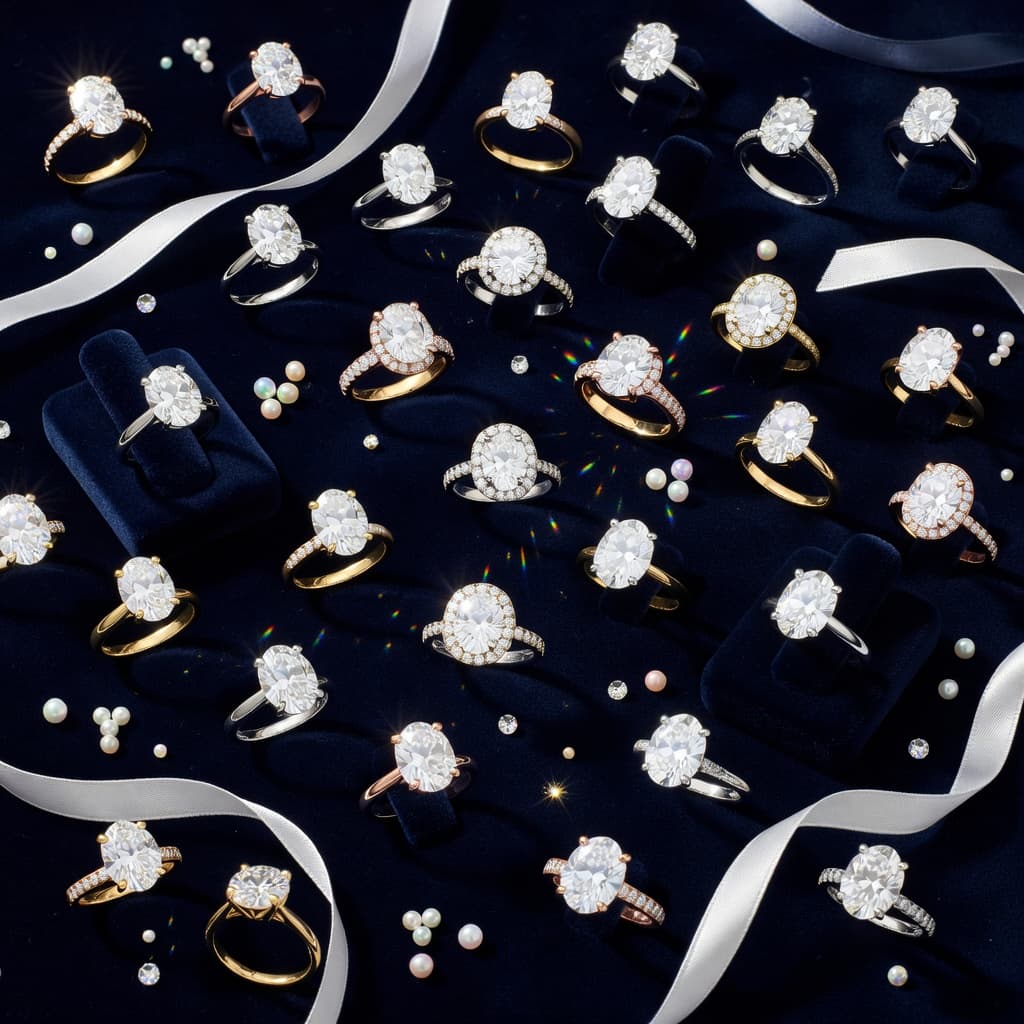
Oval engagement rings offer a rare balance of softness and presence. Their rounded outline catches light across a broad surface, while their elongated shape can make the centre stone appear larger than its actual carat weight suggests.
That appeal has made the oval a lasting alternative to the traditional round brilliant cut. Yet a beautiful result depends on more than simply choosing an elongated diamond. Cut, proportions, setting height, metal colour, and buying protections all affect how the finished ring looks and wears.
Key Takeaways
- Prioritise Cut Over Carat: While carat weight is important, the visual appeal of an oval diamond relies heavily on its proportions and light performance; a well-cut stone will often appear larger and more brilliant than a poorly cut one of greater weight.
- Watch for the Bow-Tie: Many oval diamonds feature a dark ‘bow-tie’ pattern across the centre; while subtle depth is acceptable, buyers should use video analysis to ensure this effect does not significantly hinder the stone’s overall sparkle.
- Consider Setting Durability: Because of their unique elongated shape, oval diamonds require secure settings—such as protective claws at the ends or full bezels—to prevent damage to the stone’s edges during daily wear.
- Assess Colour and Metal Together: The elongated shape can show colour more easily at the tips, so consider pairing slightly warmer diamonds with yellow or rose gold, or choosing higher colour grades for platinum and white gold settings.
What Makes an Oval Engagement Ring Different?
Oval diamonds belong to the fancy-shaped family, including the popular oval cut diamond, as well as pear, marquise, heart and cushion cuts. Unlike a round brilliant, the oval has an extended silhouette with no sharp point at either end. This gives the stone a graceful, continuous outline.
A well-proportioned oval features an elongated shape that can create the impression of longer fingers and a larger diamond face-up. Because this style is so flattering on the finger, it has become a favourite for many. Carat weight measures mass, not visible size, so two stones of equal weight can look noticeably different once set in a ring.
Pear cuts have a rounded end and a pointed tip, which gives them more directional drama. Elongated cushion diamonds often look softer and more pillowy, with broader corners and a different facet pattern. The oval sits between those styles, polished but less formal than a round stone.
The bow-tie effect and why cut quality matters
Many oval diamonds show a darker area across the centre, often described as a bow-tie. It appears when the facets do not return light evenly to the eye. While a faint bow-tie can add depth and contrast, particularly in natural daylight, a pronounced dark band can interrupt the stone’s brilliance and make the centre look flat. Grading reports record valuable information, but they cannot fully show this visual feature.
Videos, rotating views and clear photographs in varied lighting are far more revealing. A diamond should also be viewed face-up, because that is how it will appear in everyday wear.
Choosing the right length-to-width proportion
The length-to-width ratio shapes the character of an oval diamond. A longer, slimmer oval often looks elegant and lengthening. A wider stone can feel fuller, softer and more traditional.
There is no universally correct ratio. Finger shape, hand size and setting style all influence the best choice. A narrow oval in a delicate solitaire may look refined, while a broader oval can hold its own in a substantial three-stone design.
The outline should look balanced rather than overly stretched or squat. Personal preference matters more than chasing a number on a product specification.
How to Choose the Best Oval Diamond
Oval diamonds are assessed for carat weight, colour, and clarity, much like round diamonds. However, an oval cut diamond does not always receive the same detailed cut grade as a round brilliant. That leaves more responsibility with the buyer to assess visual performance.
The strongest oval has pleasing brightness, an even outline, and good symmetry. A high grade on paper does not automatically produce a lively stone.
Balance carat weight, colour and clarity
Because of its spread, an oval can look larger than a round diamond of the same carat weight. That makes millimetre measurements as important as the carat weight figure itself.
Colour becomes more visible near the pointed ends of an oval. A bright white gold setting can make warmth easier to notice, whereas yellow gold or rose gold may complement a slightly warmer diamond. The most suitable colour grade depends on the chosen metal and the appearance of the stone in person.
Clarity should be judged with ordinary viewing in mind. An eye-clean diamond can offer better value than one with technical clarity features that remain invisible without magnification. Inclusions near the centre may be more apparent, particularly beneath the main table facet.
Check measurements, symmetry and light return
Two 1-carat oval diamonds can differ in length, width, and face-up size. Comparing exact measurements prevents an apparently large carat weight from disguising a deep-cut stone with a smaller visible surface.
Look for even shoulders, matching curves, and a centred point at each end. Facets should produce crisp flashes of light rather than broad, persistent dark patches, especially when looking at the facets near the table of the stone. Magnified images and videos help assess those details before purchase.
Independent grading documentation adds another layer of reassurance. It should identify the diamond clearly and match the stone’s stated characteristics.
Settings and Metals That Suit an Oval Engagement Ring
The setting frames the diamond and determines much of the ring’s daily practicality. It also affects how large, bright or delicate the centre stone appears.
| Setting style | Appearance | Everyday consideration |
|---|---|---|
| Solitaire | Clean and focused | Easy to clean, but height varies |
| Halo | Larger-looking centre | Small stones need regular checks |
| Three-stone | More substantial profile | Can feel wider on the finger |
| Bezel | Modern and protective | Covers more of the diamond edge |
A setting should support the stone without turning it into an afterthought.
Solitaire, halo and three-stone designs
Solitaire engagement rings place the oval at the centre of attention. Four or six claws can create a classic profile, while a simple band leaves room for the diamond’s outline to do the work. Choosing solitaire engagement rings remains a timeless preference for those who want the stone to be the sole focus.
Halo engagement rings place smaller diamonds around the centre stone. They increase sparkle and can make the oval look larger, although the border may soften its distinctive shape. A hidden halo, set beneath the centre stone, adds detail visible from the side without changing the face-up outline. These designs can also be adapted for a beautiful vintage design if you prefer an ornate, period-inspired aesthetic.
Three-stone or trilogy rings use side diamonds to build a broader, more symbolic design. Tapered baguettes, pear-shaped side stones or smaller ovals can work well, but the proportions need careful planning. While diamonds are standard, a vibrant sapphire is a popular alternative centre stone often found in these settings. Additional stones also make cleaning and future repairs more involved.
Prongs, bezels and everyday security
An oval has no sharp point, yet its ends still need protection. Secure claws at the top and bottom reduce the chance of damage, while a bezel wraps metal around the edge for greater protection.
Lower-profile settings suit active routines because they are less likely to catch on knitwear or hair. Higher settings show more of the diamond’s side profile, but they can make the ring less practical for some hands.
For the metal, platinum is dense, naturally white and commonly chosen for strong claw settings. Alternatively, 18ct gold is a classic choice; 18ct white gold gives a bright, cool frame but usually needs occasional rhodium plating, while 18ct yellow gold offers warmth and can disguise lower colour grades.
A wedding band should also be considered early. A raised solitaire may allow a straight band to sit flush, while a lower setting may require a shaped wedding ring. If you want a more substantial look for your bridal set, consider pairing your ring with diamond band rings that complement the oval centre stone.
How Much Does an Oval Engagement Ring Cost in the UK?
The price of oval engagement rings depends on the diamond’s origin, size, colour, clarity, visual quality, and certification. The choice of metal, the complexity of the setting, the addition of side stones, and the level of expert workmanship also influence the total cost.
A lower price does not always equate to better value. A poorly cut centre stone, a weak setting, or a vague aftercare policy can prove more costly in the long run.
Natural versus lab-grown diamonds
Natural diamonds are formed over geological timescales and remain highly sought after due to their inherent rarity. Conversely, lab-grown diamonds possess the same chemical composition and crystal structure as their natural counterparts, but they are produced in controlled environments.
Choosing lab-grown diamonds can often allow for a larger stone or a higher specification diamond within the same budget. Alternatively, natural diamonds may appeal to those who place greater importance on geological rarity or potential long-term investment. Neither option is objectively better, as the ideal choice depends on your personal priorities, market conditions, and the quality of the finished jewellery. Regardless of your preference, ensuring you have a clear, certified description of the stone’s origin is essential.
The costs that are easy to overlook
When budgeting, remember that resizing can be straightforward on a plain band, but it may be restricted by pavé diamonds, intricate engravings, or an elaborate gallery. You should also account for additional expenses such as insurance, professional valuations, and routine maintenance inspections.
Furthermore, services like bespoke engraving, polishing, cleaning, and creating a custom wedding-band pairing can add to your overall spend. Before making a purchase, many couples look for UK retailers that offer 0% finance options to help spread the cost more effectively. Additionally, always establish what your warranty includes and whether the jeweller provides ongoing repairs or claw checks after the sale.
Buying an Oval Engagement Ring Online Without Guesswork
Shopping for oval engagement rings online provides a much wider selection than many physical high-street displays, offering the advantage of clear specification comparisons and access to a vast inventory of loose stones. While this removes the chance to inspect an oval cut diamond in person before purchase, digital tools have become sophisticated enough to make remote buying a reliable experience.
Detailed images alone are not enough; the full buying process matters. If you require specific proportions or unique design elements, look for a jeweller that offers a bespoke service to ensure your piece is tailored to your exact preferences.
What to verify before placing an order
A careful online purchase should include the following checks:
- An independent grading report that matches the stated diamond.
- Exact millimetre measurements, carat weight and metal details.
- Clear videos or rotating views that show light return and any bow-tie effect.
- A UK hallmark or clear hallmarking information for precious metals.
- Ring-size guidance, resizing terms and a written returns policy.
- Insured delivery, secure payment methods and realistic dispatch times.
- Accessible contact details, legal business information and a credible customer service record.
A seller should state whether a replacement will match the original quality if loss or damage occurs under a warranty.
How to judge value beyond the headline price
Like-for-like comparison is the only reliable way to assess price. The diamond origin, certificate, measurements, metal purity, setting style and side-stone quality should all be considered together.
A large carat figure can distract from a weak cut or an obvious bow-tie effect. Likewise, a high laboratory grade may matter less than a bright, symmetrical diamond that looks attractive in normal light.
Sizing, fit and safe delivery
Finger size can change with temperature, exercise and time of day. Wider bands often feel tighter than narrow ones, while stacking with a wedding ring can alter the fit again.
Accurate measuring before ordering reduces the need for resizing. The ring should arrive through insured delivery in discreet packaging, then be examined promptly for stone security, correct size and matching documentation. Because some intricate designs cannot be resized easily, ensure the company policy is clear before you complete your payment.
Common Mistakes to Avoid When Choosing an Oval Ring
When browsing for oval engagement rings, there are several common errors that shoppers often encounter. The most significant mistake is focusing exclusively on carat weight while neglecting the importance of measurements and brilliance. It is essential to remember that a smaller diamond with an excellent cut often displays more sparkle and looks more impressive than a larger stone that suffers from poor light return.
Other pitfalls include overlooking a prominent bow-tie effect, accepting uneven symmetry, and finalising a purchase without verified grading documentation. If you are drawn to a vintage design, ensure the setting is robust enough for your daily activities, as intricate details can sometimes compromise long-term durability. Settings deserve equal scrutiny; while delicate claws offer a refined aesthetic, they may not be suitable for every lifestyle.
Return policies should never be an afterthought, particularly when buying online. Additionally, you should factor insurance, professional valuations, and routine maintenance into your financial planning from the start.
An oval diamond earns its appeal through proportion and light, not through a carat figure alone.
Frequently Asked Questions
Do oval engagement rings make fingers look longer?
Yes, the elongated silhouette of an oval diamond creates an optical illusion that helps to lengthen the appearance of the finger. This flattering effect is one of the primary reasons many buyers choose this shape over traditional round brilliant cuts.
What is the ideal length-to-width ratio for an oval diamond?
There is no single ‘perfect’ ratio, as it depends entirely on your personal style and finger shape. Generally, a ratio between 1.30 and 1.50 is considered standard, with lower numbers appearing fuller and higher numbers appearing more slender and elegant.
How does an oval diamond compare to a round one in price?
Oval diamonds are often more affordable per carat than round brilliant cuts, as the rough diamond loses less weight during the cutting process. However, because cut quality is harder to quantify for fancy shapes, you should focus on the visual performance of the specific stone rather than just the price tag.
Is an oval diamond as durable as a round one?
An oval diamond is durable for daily wear, but because it lacks a sharp protective girdle at the points, it is important to ensure the setting includes secure prongs at the top and bottom. Choosing a high-quality setting will provide the necessary protection to keep your stone safe from accidental knocks.
Conclusion
The strongest oval engagement ring combines an attractive outline with lively light performance, secure construction, and a metal that suits both the diamond and its wearer. Technical grades matter, yet they cannot replace a close look at symmetry, measurements, and the bow-tie effect.
An oval engagement ring brings together personal style and careful judgement. The enduring appeal of these stones lies in that balance, offering a choice that looks soft and expressive while rewarding those who pay close attention to detail.
Explore our Buyers Guides and Reviews
For a list of our main buyers guides use the drop-down menu at the top of the page. Topics related to this article are:
–
Explore Our Blog Categories for Expert Buying Advice
- AI Powered Product Finder Tools (25)
- Expert Buying Guides & Shopping Tips for UK Shoppers (1,370)
- Brands & Designer Products (Men, Women & Electronics) (273)
- Designer Fashion Brands: Buyer’s Guides & Reviews (153)
- Electronic Brands: Buyers Guides & Reviews (86)
- Apple Products Buyer’s Guides & Reviews (24)
- Brands – Phones, Laptops, PC”s, Tablets | Buyer’s Guides & Reviews (42)
- Electronics – Tablet & iPad Reviews and Buyers Guides (11)
- Kitchen Appliance Brands: Buyer’s Guides & Reviews (22)
- Laptop Brands & MacBooks Buyer’s Guides & Reviews (9)
- Phone Brands & iPhones Buyer’s Guides & Reviews (23)
- Car Buying & Financing Made Easy | Expert Guides for the UK (89)
- Clothing, Fashion & Accessories Buying Guides UK (455)
- Beauty, Health & Wellness | Perfume, Skincare, Makeup & Wellbeing Guides (166)
- Footwear: Trainers & Shoes Buyers Guides (46)
- Jewellery: Expert Reviews, Trends & Buying Guides (71)
- Men's Clothes — Buyers Guides & Reviews (38)
- Men’s Clothes, Fashion & Accessories Guides UK | Latest Trends & Smart Shopping (156)
- Women's Clothing Buyers Guides — Dresses, Tops & More (173)
- Women’s Clothes, Fashion & Accessories Guides UK | Latest Trends & Smart Shopping (396)
- Electronics, Tech & Gadgets: Reviews, Deals & Buying Guides UK (170)
- Furniture Buyer’s Guides | Home & Garden & Styling Tips (314)
- Bedroom Furniture Guides UK | Expert Tips & Best Value Deals (91)
- Garden Furniture, Landscaping & Garden Rooms Guides UK | Expert Tips & Best Value Deals (159)
- Garden Sofa & Sofa Sets Buyers Guides (11)
- Garden Tables & Chairs: Sets, Individual Tables & Seating Buyers Guides (43)
- Home Furniture, Décor & Interior Design Guides UK | Styling Tips & Inspiration (167)
- Living Room Furniture, Design & Décor Guides UK | Styling Tips & Inspiration (57)
- Sofa & Sofa Beds Buyers Guides (19)
- Sofa Beds Buyers Guides (7)
- Sofa Buyers Guides & Expert Advice (11)
- Holidays & Travel: Hotels, Villas & Flights (159)
- Home & Garden Improvements | Renovations & Outdoor Transformation Guides (99)
- Insurance & Protection: Travel, Landlord, Gadget & More UK (159)
- Gadget Insurance UK | Expert Guides, Reviews & Smart Protection Tips (33)
- Home Emergency Cover UK | Expert Guides, Reviews & Practical Protection Tips (21)
- Landlords Insurance UK | Expert Guides, Reviews & Smart Protection Tips (31)
- Travel Insurance UK | Expert Guides, Reviews & Money-Saving Tips (34)
- Pets: Guides, Tips & Inspiration (26)
- Brands & Designer Products (Men, Women & Electronics) (273)
- Gifts for Everyone: Ideas for Every Occasion & Budget (45)