Buying a used car in the UK can feel like revising for an exam you never wanted to sit. Hundreds of models, strange trim names, warnings about dodgy motors, and everyone you know has a different opinion.
An AI car buyers guide acts like a calm, car‑savvy friend in your pocket. It asks you a few simple questions about your budget, type of car, fuel, and how you drive, then suggests a short list of used cars that actually fit your life.
In this guide you will see how these AI tools work, what good ones always consider, how to feed them the right details, and where their limits lie. You stay in control, they just tidy the chaos so your choice feels clearer and less stressful.

Feeling lost in endless used car searches is common. Image created with AI.
What Is an AI Car Buyers Guide and How Does It Work?
At heart, an AI car buyers guide is a smart question and answer system. Instead of you trawling adverts and guessing, it listens to your needs and does the heavy thinking in the background.
It works a bit like a chat with a friendly assistant on your phone. You type simple answers, it replies with clear suggestions that match those answers, not whatever happens to be popular that week.
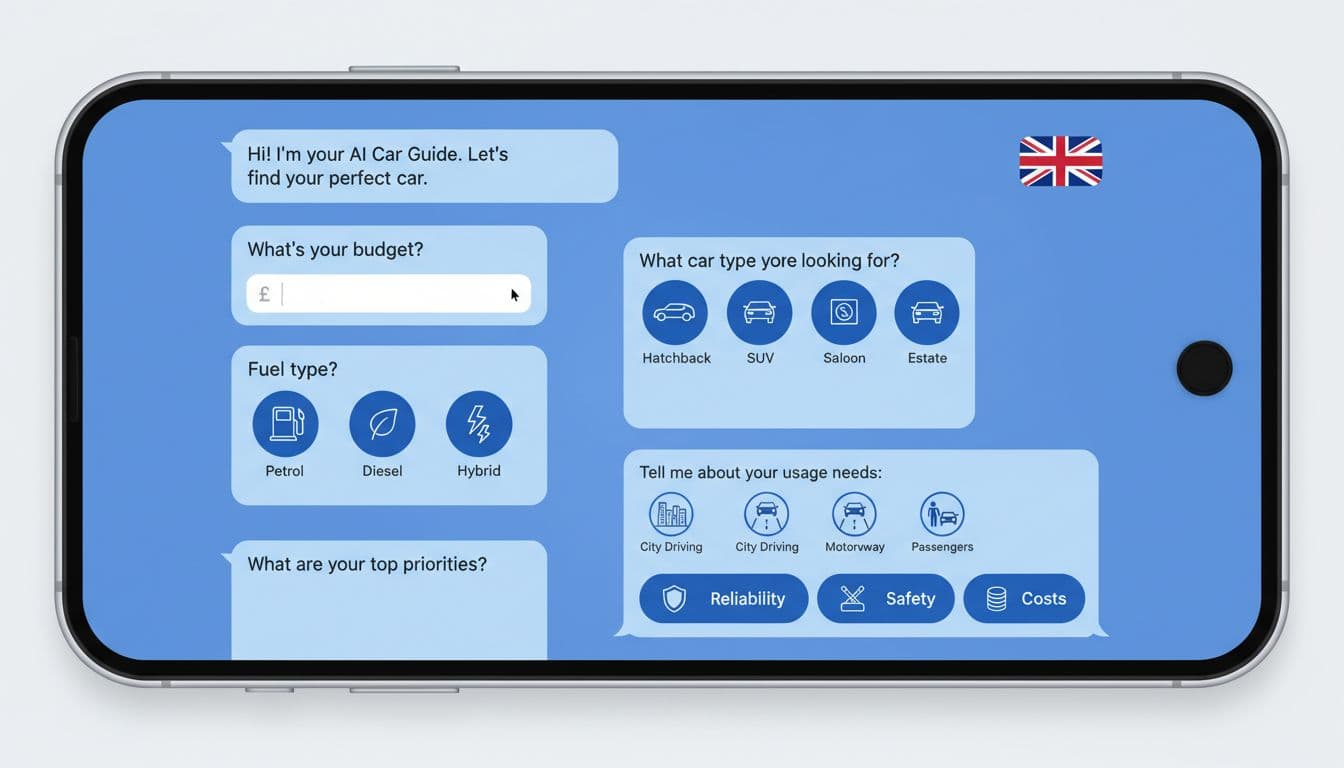
An AI car buyers guide usually runs as a simple chat. Image created with AI.
From endless car searches to smart questions and clear answers
The old way meant tabs full of adverts, reviews, and “top 10” lists. You might ask friends, each with a different story, then still feel none the wiser.
An AI guide flips that. It starts by asking focused questions about your budget, car size, fuel type, and how you drive. Within a few minutes you get a tight shortlist, along with plain English reasons why each car could suit you.
Time spent guessing turns into time spent comparing a handful of sensible options.
Key inputs AI uses to find the best used car for you
Good AI car buyers guides rely on a small set of clear inputs. Each one tells the assistant something important about what will work for you.
- Currency and budget: You pick a currency, usually £ in the UK, and give a realistic range, for example £5,000 to £8,000. The AI uses this to avoid cars that usually sit far above what you can pay.
- Car type: You choose from simple labels like small hatchback, saloon, or small SUV. This tells the AI how much space and presence on the road you want.
- Fuel type: Petrol, diesel, hybrid, or electric. This sets hard limits and helps match your running costs and driving style.
- Usage needs: Things like commute distance, school runs, regular long trips, passengers, and city versus motorway use. This steers the AI toward cars that cope well with your routine.
- Must‑have priorities: Reliability, low running costs, safety, performance, tech, comfort, space, resale value, and so on. Your ranking here guides the trade offs.
Each answer cuts away a chunk of the market so the AI can focus on cars that fit real life, not just glossy brochures.
How AI turns your needs into real used car models
Behind the scenes, the AI uses its training on car data and simple rules to filter models. It treats your budget, car type, and fuel type as hard boundaries. If you pick a used small hatchback on petrol for £6,000, it will not suggest a large luxury diesel saloon.
Next, it uses your usage needs and priorities to fine tune. For high motorway mileage it will favour stable, economical cars. For city streets and tight parking it will lean toward compact, easy to park models. It usually highlights common, mainstream cars with a good track record, not rare, modified, or exotic choices.

AI guides tend to favour sensible, mainstream used cars. Image created with AI.
What a Good AI Car Buyers Guide Should Always Consider
Not every AI tool is equal. Some follow sensible rules, others feel more like guesswork. A good guide should feel like a careful friend who respects your limits.
Use these points to judge whether the advice you get sounds solid or sloppy.
Respecting your budget and car type limits
Your budget, body style, and fuel choice are non‑negotiable. A trustworthy AI guide treats them as firm lines, not suggestions.
If you say £4,000, small hatchback, petrol, you should see modest, common models that usually fit that money. You should not see high powered hot hatches or prestige badges that sit far above typical prices. The same goes for car type; ask for a small SUV and it should not keep pushing big saloons.
If it repeatedly ignores what you have set, treat its ideas with caution.
Matching fuel type to your real driving pattern
Fuel type is not just a preference, it shapes your costs and comfort. A smart AI guide uses your usage details to check what really works.
Here is a simple way it may think about it:
| Fuel type | Best for | Things to keep in mind |
|---|---|---|
| Petrol | Short trips, mixed city and A‑roads, low to medium mileage | Often cheaper to buy, simple for town driving |
| Diesel | Regular long journeys, high annual mileage, lots of motorway | Better on fuel on long runs, less ideal for city |
| Hybrid | Mixed use, stop‑start traffic, drivers who like quiet, smooth progress | Can cut fuel use round town |
| Electric | Short to medium trips, home charging, steady local use | Very cheap to “fuel”, range matters on long runs |
A good AI guide connects your commute length, trip pattern, and charging access to these broad rules, then suggests models that fit.
Balancing reliability, running costs, and safety with comfort and tech
Most people want a car that starts every morning and does not drain their wallet. A careful AI guide leans toward reliable models with fair running costs and strong safety scores, especially for family or commuting use.
Your priorities tell it where to bend. If you rank reliability and low running costs above everything, it will pick proven, sensible models, even if the interiors feel a bit plain. If you push comfort, tech, or performance higher, it may move you toward better equipped trims or slightly sportier versions, while still watching fuel economy and insurance.
Clear priorities help it choose between “boring but bombproof” and “nicer to sit in but a touch pricier to run”.
Choosing mainstream used models and avoiding risky niche choices
Good AI car buyers guides prefer cars you can actually find and keep on the road easily. That usually means well known brands and models with lots of cars for sale at different ages and mileages.
They tend to avoid very rare imports, heavily modified cars, or ageing high end models unless you clearly ask for sports or luxury with a strong budget. This focus helps with:
- Parts and servicing
- Insurance costs
- Finding another car if one deal falls through
- Everyday dependability
Safe and common often beats flashy and awkward in the long run.
How to Get the Best Used Car Advice From an AI Guide
To get sharp advice, you need sharp inputs. Think of it like talking to a mechanic; the clearer you are, the better the answers.

A good AI shortlist should lead to confident real‑world test drives. Image created with AI.
Give a clear budget and stick to one currency
Start by picking a single currency, usually pounds. Then give a realistic range, not just one number. For example, “My budget is £6,000 to £8,000, and I would like to stay nearer the lower end.”
Remember that lower budgets usually mean older cars with higher mileage. Say so if you are open to that, or if you would rather go smaller and newer.
This lets the AI filter to cars that you can sensibly buy, not dream about.
Describe your journeys, passengers, and parking in simple terms
The AI does not know your life unless you spell it out. Plain descriptions work best. For example:
- “I drive 10 miles each way to work, mostly in town.”
- “I do one 150 mile motorway trip most months.”
- “I need room for two adults, two children, and a buggy.”
- “Parking is on a narrow terraced street, space is tight.”
These details help it judge car size, boot space, and fuel type. You end up with models that fit your driveway and your weekend shop, not just your wish list.
Rank your must‑have priorities so AI knows what to trade off
Try to list your top three to five priorities in order. For example:
- Reliability
- Low running costs
- Safety
- Comfort
- Tech features
This tells the AI what to protect if there is a clash. A young driver might put low insurance and safety first. A family might push reliability, space, and safety. A high mileage commuter may care most about fuel economy and comfort.
When the AI has to choose between a punchy engine and a cheaper to run one, your ranking guides that call.
Ask for 3 to 5 specific used car models and why they fit you
If you ask for “recommendations”, some tools throw out long lists. That just recreates the stress you started with.
Instead, try wording like: “Please suggest 3 to 5 specific used car models that fit my budget, fuel type, and usage, and explain why each one suits me along with a typical used price range.”
You should then see a tidy list such as:
- Model
- Why it fits you, linked to your needs
- Typical used price range within your budget
This makes comparing options far easier.
Use AI tips on trims, engines, and model years before you go viewing
Once you have a shortlist, go one step further with the same guide. Ask things like:
- Which engines or gearboxes are most reliable for these models?
- Which trims give good kit without silly running costs?
- What model years are best for value and updates?
- Are there any common issues or recalls to check?
You do not need technical knowledge. The AI can point to sensible age and mileage ranges, for example 5 to 8 years old with moderate miles, and highlight common trouble spots to watch for during viewings and test drives.
Limitations of AI Car Buyers Guides and How to Stay in Control
AI can tidy your options, but it does not hold the keys. You still make the choice, and you still need basic checks.

AI can shortlist models, but a human still checks the actual car. Image created with AI.
Why AI suggestions are a starting point, not the final decision
AI works with patterns, not with the actual car sitting on a driveway. It can suggest solid models and years, but it cannot see rusty arches, fake service stamps, or a smoky exhaust.
Treat its output as a smart shortlist, nothing more. You still need to check each specific car, read its history, and see how it feels to drive.
Cross checking AI advice with real world information
Once you have AI suggestions, spend a bit of time cross checking them. Some simple steps:
- Compare what different sources say about the same models
- Read owner comments and long term reviews
- Look up safety ratings for the cars on your list
- Ask a trusted mechanic what they think of those models
- Get any car you are serious about inspected and test driven
This mix of AI, human opinion, and hands‑on checks gives you a far firmer footing than any one source alone.
Staying realistic about budget, age, and expectations
Even the best AI cannot bend market reality. A very low budget often means older, higher mileage cars, and those naturally carry more risk. A model known for reliability can still be a headache if it has missed services or been abused.
Be honest with yourself about what your money can buy. Use the AI to find the best of what is realistic, not to chase bargains that look too good to be true.
Conclusion
AI car buyers guides can turn a foggy used car hunt into a focused shortlist of sensible, mainstream models that match your budget, fuel choice, and daily life. By giving clear inputs on money, journeys, passengers, and priorities, you help the AI assistant act more like a switched on friend and less like a random quiz.
Use its suggestions to spot good candidates, then back them up with your own research, real world advice, and careful viewings and test drives. The goal is simple; a used car that quietly fits your life, rather than one that only looks impressive on paper.
–
Shop for More with Our Verified UK Insurance providers:
Home Emergency Cover Home Appliance Cover– Income Protection insurance
Travel Insurance – Gadget Insurance – Phone Insurance – Caravan Insurance – Cycle Insurance – E-Bike Insurance
Car Finance – Car Breakdown Cover – Van Breakdown Cover – Motorbike Breakdown Cover
–
Explore our Buyers Guides with Money Saving Tips
For a list of our main buyers guides use the drop-down menu at the top of the page. Topics related to this article are:
Laptop Insurance Buyers Guides
Gadget Insurance Buyers Guides
Tennant’s Insurance Buyers Guide
Landlords Insurance Buyers Guide
Home Emergency Cover Buyers Guide
Travel Insurance Buyers Guides
Car Breakdown Cover Buyers Guide
–
Explore Our Blog Categories for Expert Buying Advice
- AI Powered Product Finder Tools
- Apple Products Buyer’s Guides & Reviews
- Beauty, Health & Wellness | Perfume, Skincare, Makeup & Wellbeing Guides
- Bedroom Furniture Guides UK | Expert Tips & Best Value Deals
- Beds Buying Guides UK | Types, Tips & Best Deals
- Brands – Phones, Laptops, PC”s, Tablets | Buyer’s Guides & Reviews
- Brands & Designer Products (Men, Women & Electronics)
- Car Buying & Financing Made Easy | Expert Guides for the UK
- Car Rental Worldwide: Compare Prices for UK Travellers
- Christmas Essentials: Decorations & Gift Ideas
- Clothing, Fashion & Accessories Buying Guides UK
- Designer Fashion Brands: Buyer’s Guides & Reviews
- Diamond Jewellery Buyers Guides & Shopping Tips
- Electronic Brands: Buyers Guides & Reviews
- Electronics – Tablet & iPad Reviews and Buyers Guides
- Electronics, Tech & Gadgets: Reviews, Deals & Buying Guides UK
- Europe Holidays & Hotels: Destinations Guides & Flights
- Expert Buying Guides & Shopping Tips for UK Shoppers
- Flooring: Wood, Laminate, Carpets and Floor Tiles Buyers Guides
- Footwear Brands: Reviews & Buyer’s Guides
- Footwear: Trainers & Shoes Buyers Guides
- Furniture Buyer’s Guides | Home & Garden & Styling Tips
- Gadget Insurance UK | Expert Guides, Reviews & Smart Protection Tips
- Game Reviews — PlayStation, Xbox, Nintendo & PC
- Gaming Buyers Guides — Consoles, Games, Keys & More
- Garden Furniture UK: Expert Reviews, Deals & Buying Guides
- Garden Furniture, Landscaping & Garden Rooms Guides UK | Expert Tips & Best Value Deals
- Garden Rooms, Offices & Garden Buildings Guides UK | Expert Tips & Best Value Deals
- Garden Sofa & Sofa Sets Buyers Guides
- Garden Tables & Chairs: Sets, Individual Tables & Seating Buyers Guides
- Gemstone Jewellery Buyers Guides
- Gifts for Everyone: Ideas for Every Occasion & Budget
- Gold Jewellery Buyers' Guides & Shopping Tips
- Holidays & Travel: Hotels, Villas & Flights
- Home & Garden Improvements | Renovations & Outdoor Transformation Guides
- Home Décor, Interior Design & Styling Tips UK | Inspiration & Expert Advice
- Home Emergency Cover UK | Expert Guides, Reviews & Practical Protection Tips
- Home Furniture Guides UK | Expert Tips & Best Value Deals
- Home Furniture, Décor & Interior Design Guides UK | Styling Tips & Inspiration
- Insurance & Protection: Travel, Landlord, Gadget & More UK
- iPhone Buying Guides, Reviews & Comparisons for the UK
- iPhone Insurance UK | Expert Guides, Reviews & Smart Protection Tips
- Jewellery Rings Buyers' Guides & Shopping Tips
- Jewellery: Expert Reviews, Trends & Buying Guides
- Kitchen Appliance Brands: Buyer’s Guides & Reviews
- Kitchen Appliances UK: Buyers Guides, Reviews & Money Saving Tips
- Landlords Insurance UK | Expert Guides, Reviews & Smart Protection Tips
- Laptop Brands & MacBooks Buyer’s Guides & Reviews
- Laptop Brands: Buyer’s Guides & Reviews
- Living Room Furniture, Design & Décor Guides UK | Styling Tips & Inspiration
- Makeup – Expert Buyers Guides & Reviews
- Men's Clothes — Buyers Guides & Reviews
- Men’s Clothes, Fashion & Accessories Guides UK | Latest Trends & Smart Shopping
- Men’s Fragrance Brands: Perfume & Aftershave Reviews & Buyers Guides
- Perfume & Aftershave Brands: Reviews & Buyers Guides
- Perfume & Fragrance: Best Scents, Reviews & Buying Guides
- Pets: Guides, Tips & Inspiration
- Phone Brands & iPhones Buyer’s Guides & Reviews
- Phone Brands: Buyer’s Guides & Reviews
- Phone Insurance UK | Expert Guides, Reviews & Smart Protection Tips
- Skincare — Expert Buyers Guides & Reviews
- Sofa & Sofa Beds Buyers Guides
- Sofa Beds Buyers Guides
- Sofa Buyers Guides & Expert Advice
- Sportswear Brands: Reviews & Buyers Guides
- Supplements Buyers Guides — Expert Tips & Recommendations
- Trainer Brands: Reviews & Buyer’s Guides
- Travel Insurance UK | Expert Guides, Reviews & Money-Saving Tips
- UK Holidays & Hotels: Destinations Guides & Flights
- Women's Clothing Buyers Guides — Dresses, Tops & More
- Women’s Clothes, Fashion & Accessories Guides UK | Latest Trends & Smart Shopping
- Women’s Designer Brands: Buyer’s Guides & Reviews
- Women’s Designer Shoe Brands: Buyer’s Guides & Reviews
- Women’s Dresses | Online Shopping Guides, Style Tips
- Women’s Perfume Brands: Reviews & Buyers Guides