A car breaking down is rarely just a car problem in a family home. It’s the school run, the commute, the weekly shop, and the carefully planned lifts that fall apart in one cough from the engine. When your household has more than one car (and more than one driver), the cost of sorting breakdown cover can quietly creep up too.
Family car breakdown cover doesn’t have to mean paying for separate policies and hoping they all work the same way. The trick is knowing whether you need cover for the vehicles, the people, or both, then comparing like for like. Multi‑car breakdown policies and family or personal cover can reduce costs, but only if you don’t buy gaps by mistake.
Prices and features vary a lot, so this guide focuses on how the cover types work, what to check, and where the real savings usually come from.
Family car breakdown cover explained, what you are actually buying
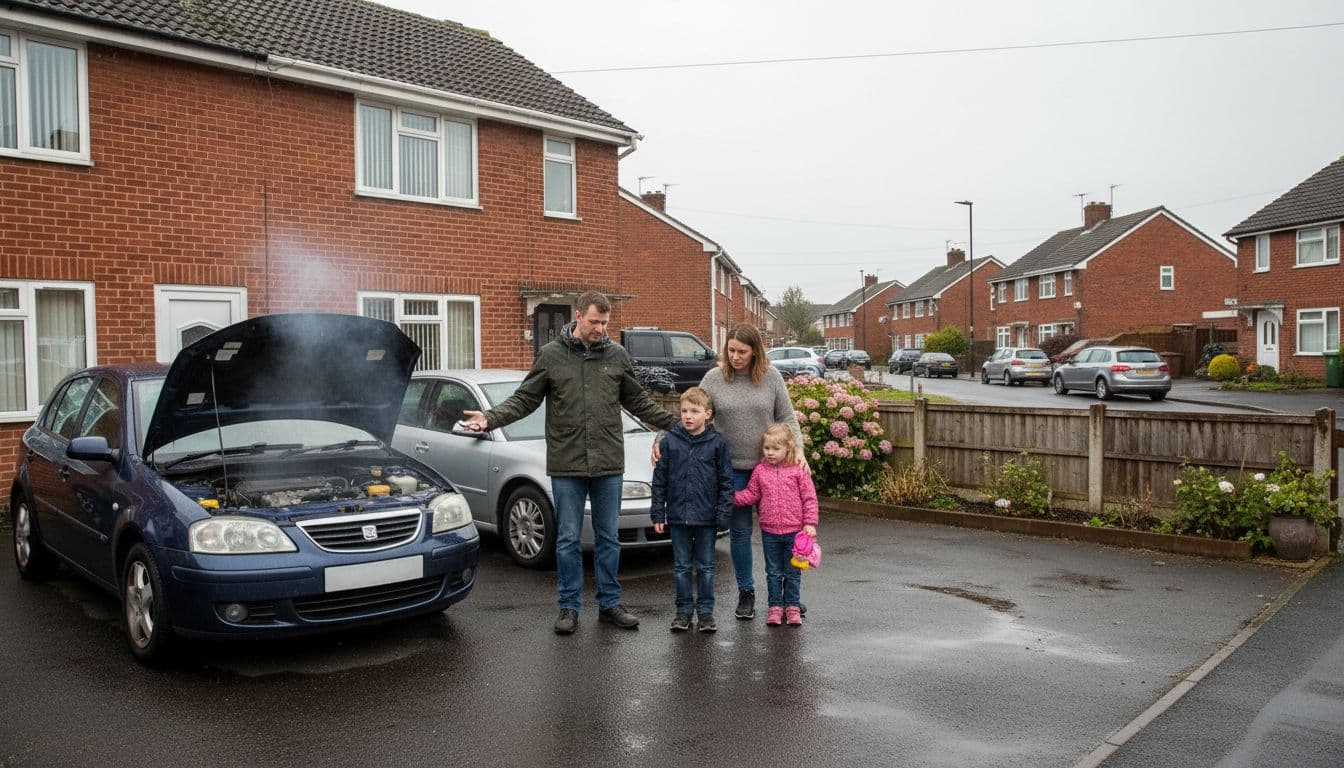 An everyday family breakdown moment on a UK driveway, created with AI.
Breakdown cover is a service plan, not car insurance. Car insurance helps with accidents, theft, and damage claims. Breakdown cover is about getting you moving again when the car won’t, whether that’s a flat battery, a starter motor giving up, or an overheating engine on the hard shoulder.
Think of it like paying for a reliable lifeboat. You hope you won’t need it, but if you do, you want it to arrive quickly and do the right job.
Most UK breakdown policies are built from a few service levels:
- Roadside assistance: Help if you break down away from home. The provider tries a repair at the roadside, or tows you to a nearby garage if not.
- Home start: Help if your car won’t start at home (often defined as your address, or within a short distance from it).
- Recovery: Towing beyond the “nearest garage” rule, sometimes to a destination of your choice within the UK.
- Onward travel: Support if the car can’t be fixed quickly (a hire car, hotel stay, or public transport costs, usually up to set limits).
- European cover: Assistance when driving abroad, often with separate terms and restrictions.
The cheapest policy can cost more later if it doesn’t fit real life. If your cars often fail on the driveway, roadside cover alone can be a false economy. If you do long motorway trips, recovery and onward travel matter more than an extra couple of pounds off the annual price.
Vehicle based vs person based cover, which is better for families
This is the decision that shapes everything else.
Vehicle based cover is tied to a specific car. If that car breaks down, it’s covered, no matter who is driving (as long as they’re allowed to drive it). This can suit households where each car has its “main driver” and the cars are rarely swapped.
Person based cover (often called personal cover) follows the driver. It can cover you in any eligible vehicle you’re driving, and sometimes as a passenger too, depending on the policy. Some versions let you add a partner, or cover a whole family by naming members.
For families, person based cover can be a better fit when:
- Partners regularly drive each other’s cars.
- One car is shared for school runs, errands, and shifts.
- An older child borrows a parent’s car (with permission and correct insurance).
- You sometimes use a courtesy car while yours is in the garage.
Vehicle based cover can make more sense when:
- Each car has a clear owner and rarely gets swapped.
- You want the car covered even if a visiting family member drives it.
- You’re more concerned about “the vehicle” being rescued than “the person” being rescued.
The key is to match cover to behaviour, not to how you wish your week ran.
What is usually included, and common exclusions that catch people out
Most policies include basics such as a 24/7 helpline, roadside call outs, and towing within set rules. Beyond that, the detail matters, and families often get caught out by assumptions.
Common inclusions (vary by level) include:
- Roadside diagnostics and minor repairs
- Towing to a garage if the car can’t be fixed
- Help arranging onward travel or accommodation (if purchased)
Common exclusions or limits that can bite:
- Pre‑existing faults (issues you knew about, or that show signs of ongoing problems)
- Maintenance issues (unsafe tyres, worn parts, lack of oil or coolant)
- Flat batteries (sometimes covered, sometimes limited, sometimes treated as wear and tear)
- Misfuelling or wrong fuel type (often an add‑on, or excluded)
- Keys locked in the car (may be excluded or limited)
- Running out of fuel (some policies help, others charge)
- Vehicle not roadworthy (bald tyres, warning lights ignored, illegal modifications)
Two definitions to read before you buy:
What counts as a “breakdown”: some policies have narrow wording.
What counts as “home”: home start is usually distance based, and the rule can be strict.
Multi car vs family policies, how they work and where the savings come from
A lot of people search for “family breakdown cover” when what they really want is a cheaper way to cover two or three cars. There are two main routes.
Multi‑car breakdown cover is one policy that covers multiple vehicles, usually kept at the same address. You choose the service level, then add each car. Savings often come from reduced admin costs, one renewal date, and pricing that gets better as you add more cars.
Family or personal breakdown cover is one policy that covers one person (or several named family members). It’s not really about how many cars you own. It’s about who needs help, and whether they drive different vehicles.
Here’s a simple comparison to keep the terms straight:
| Feature | Multi‑car breakdown policy | Family/personal breakdown cover |
|---|---|---|
| What’s covered | The listed vehicles | The listed people (in eligible vehicles) |
| Best for | Households with 2+ cars at the same address | Households sharing cars, borrowing cars, or driving different vehicles |
| Typical saving | Lower per‑car cost as cars are added | One policy can cover multiple drivers, even across different cars |
| Main risk | Assuming drivers are covered in any car | Assuming every household car is covered automatically |
Savings are real, but value can flip quickly if one car needs extras (like recovery) and another doesn’t, or if the policy structure forces you to pay for upgrades you won’t use.
When a multi car breakdown policy is likely to be cheaper
Multi‑car breakdown cover often wins on price when the household setup is simple.
It tends to suit you if:
- You have two or more cars registered to the same home address.
- Both cars need broadly the same protection (for example, home start plus recovery).
- You’d rather manage one renewal date than track separate policies.
- You do a mix of commuting, school runs, and weekend trips, and want consistent cover for each vehicle.
Savings can grow when adding a third car because some pricing structures reward extra vehicles. Still, check whether the cost jumps if you add a car that falls outside vehicle eligibility rules (often linked to age, size, or type).
Also watch out for mixed needs. If one car is older and more likely to fail at home, you might want home start for that car, but not for the newer one. Some multi‑car options make you buy the same level across all cars, which can wipe out the saving.
When family or personal breakdown cover can beat multi car
Personal cover can cost less, and cover more real life driving, when the people move between vehicles.
It can be a better deal if:
- You and your partner swap cars often.
- A new driver in the house drives different vehicles (their own small car, plus a parent’s car sometimes).
- You travel as passengers a lot and want help even when you’re not driving (policy dependent).
- You sometimes drive cars you don’t own (with permission and correct insurance).
Before relying on personal cover, check the rules that change everything:
Age limits and licence conditions: some policies restrict who can be added.
Driving other cars: confirm whether the cover applies when you’re driving someone else’s vehicle, and whether that vehicle has to meet eligibility rules.
What “recovery” means: some personal policies focus on getting you home, not transporting the car where you want it.
How to compare policies and cut costs without losing cover you need
Comparing breakdown cover is easier if you start with your weekly reality, not the headline price. Make a quick note of:
- Where the cars are parked overnight
- Who drives what, and how often
- Your typical journeys (short local trips, motorway miles, or both)
- Your risk points (older car, frequent flat battery, long trips with kids)
Then compare policies on the parts that affect your costs when something goes wrong.
Quick checklist to compare like for like cover
Use this to line up two quotes side by side:
- Roadside only or roadside plus recovery: do you need towing beyond a local garage?
- Home start rules: is “home” your address, or within a set distance?
- Recovery destination: nearest garage only, or to any UK destination?
- Number of call outs: capped per year, or unlimited?
- Limits per incident: any maximum spend or towing distance cap?
- Onward travel: hire car, hotel, public transport, and the limits on each
- Response time promises: what’s stated, and what’s excluded (bad weather, peak times)
- Trailer or caravan cover: if you tow, check it’s included
- Does cover follow you: in another car, as a passenger, or only in the insured vehicle?
One small detail can change the true cost. A low annual premium is less appealing if you end up paying for a long tow, or arranging your own transport home after a motorway breakdown.
Cost saving moves families can use, with the trade offs
You can often cut the price without cutting the usefulness, as long as you’re honest about how you travel.
Choose only the add‑ons you’ll use: If you rarely travel far, onward travel might be less important than home start. If you do long drives to visit family, it can be the opposite.
Pay annually if it’s cheaper: Monthly payments can cost more overall. Annual payment can help, but only if it doesn’t strain cashflow.
Avoid duplicate cover: Some current accounts, warranties, or new‑car packages include breakdown assistance. Duplicates can mean paying twice for the same tow truck.
Keep your details accurate: The wrong fuel type, wrong address, or missing vehicle details can cause delays or refusal.
Review at renewal: Families change quickly. A new job, a new car, a new driver in the home, it can all flip which policy type is best.
Trade‑offs to think about:
- Skipping home start can backfire if your car often fails on the driveway.
- Choosing roadside only can be risky if you do long motorway trips.
- Picking a cheaper policy with tight claim limits can mean surprise charges.
Real world family scenarios, which option usually wins
Scenario 1: Two parents, two cars, both commute
Multi‑car breakdown cover often works well here, because each vehicle needs similar protection and both are used daily. Double check home start distance rules and whether recovery is “nearest garage” or your choice.
Scenario 2: One family car used by everyone, including a learner with supervision
Vehicle based cover can be simplest, because the car is the constant. Double check who can drive under the terms (learner drivers and supervised driving rules vary) and whether call outs are limited.
Scenario 3: Older teen has a small car, parents share a second car
This is where value can swing. Multi‑car can be good if both vehicles need the same level. Personal cover can be better if the teen sometimes drives the parents’ car, or if parents often drive the teen’s car to help out. Double check age and licence rules for adding family members.
Scenario 4: One partner sometimes drives a company car
Personal cover can be the better fit because it follows the driver, not the household vehicle list. Double check whether driving a company car is allowed under the policy, and whether business use affects eligibility.
Questions to ask before you buy, so you do not pay twice or get refused help
Breakdown cover is one of those products that feels simple until you need it. Asking a few direct questions now can prevent a bad surprise later, such as a refused call out or a big recovery bill.
The key questions that reveal the true cost
- Does it cover breakdown at home, and how far from home counts?
- Is recovery to any UK destination included, or just to a local garage?
- How many call outs can I have per year?
- Are parts and labour included, or is it only roadside help and towing?
- Is there a limit per claim (money, miles, or time)?
- Are punctures, flat batteries, and misfuelling covered, and under what terms?
- If I’m driving someone else’s car, am I covered, and does that car need to meet any rules?
- Are all drivers covered, or only named people?
- What happens if the vehicle is judged not roadworthy?
If a provider can’t answer clearly, that’s a sign to slow down.
Common mistakes families make when switching or bundling
- Assuming multi‑car means “family cover” for anyone in any car
- Forgetting to add the second (or third) vehicle, especially after changing cars
- Overlapping cover with a packaged bank account or warranty
- Choosing roadside only, then realising you need recovery for long trips
- Not checking vehicle eligibility (age, size, modifications, or use type)
- Letting a policy auto‑renew without rechecking price and features
Conclusion
The cheapest breakdown cover for a household usually comes down to one thing: do you need cover for the cars, the people, or a mix of both? When you match the policy to who drives what, where your cars live overnight, and the journeys you actually do, multi‑car and family or personal options can cut costs without cutting help.
Write down your must‑haves (home start, recovery, onward travel), check for duplicate cover you already have, then compare fresh quotes on those exact features. Your future self, stuck on the driveway or the motorway, will thank you for choosing cover that works when it matters most.
Explore our Buyers Guides and Reviews
For a list of our main buyers guides use the drop-down menu at the top of the page. Topics related to this article are:
Laptop Insurance Buyers Guides
Gadget Insurance Buyers Guides
Tennant’s Insurance Buyers Guide
Landlords Insurance Buyers Guide
Home Emergency Cover Buyers Guide
Travel Insurance Buyers Guides
Car Breakdown Cover Buyers Guide
–
Explore Our Blog Categories for Expert Buying Advice
- AI Powered Product Finder Tools (26)
- Expert Buying Guides & Shopping Tips for UK Shoppers (1,352)
- Brands & Designer Products (Men, Women & Electronics) (270)
- Designer Fashion Brands: Buyer’s Guides & Reviews (151)
- Electronic Brands: Buyers Guides & Reviews (85)
- Apple Products Buyer’s Guides & Reviews (23)
- Brands – Phones, Laptops, PC”s, Tablets | Buyer’s Guides & Reviews (41)
- Electronics – Tablet & iPad Reviews and Buyers Guides (11)
- Kitchen Appliance Brands: Buyer’s Guides & Reviews (22)
- Laptop Brands & MacBooks Buyer’s Guides & Reviews (9)
- Phone Brands & iPhones Buyer’s Guides & Reviews (22)
- Car Buying & Financing Made Easy | Expert Guides for the UK (89)
- Clothing, Fashion & Accessories Buying Guides UK (447)
- Beauty, Health & Wellness | Perfume, Skincare, Makeup & Wellbeing Guides (163)
- Footwear: Trainers & Shoes Buyers Guides (46)
- Jewellery: Expert Reviews, Trends & Buying Guides (71)
- Men's Clothes — Buyers Guides & Reviews (38)
- Men’s Clothes, Fashion & Accessories Guides UK | Latest Trends & Smart Shopping (155)
- Women's Clothing Buyers Guides — Dresses, Tops & More (170)
- Women’s Clothes, Fashion & Accessories Guides UK | Latest Trends & Smart Shopping (389)
- Electronics, Tech & Gadgets: Reviews, Deals & Buying Guides UK (169)
- Furniture Buyer’s Guides | Home & Garden & Styling Tips (310)
- Bedroom Furniture Guides UK | Expert Tips & Best Value Deals (91)
- Garden Furniture, Landscaping & Garden Rooms Guides UK | Expert Tips & Best Value Deals (156)
- Garden Sofa & Sofa Sets Buyers Guides (10)
- Garden Tables & Chairs: Sets, Individual Tables & Seating Buyers Guides (39)
- Home Furniture, Décor & Interior Design Guides UK | Styling Tips & Inspiration (166)
- Living Room Furniture, Design & Décor Guides UK | Styling Tips & Inspiration (56)
- Sofa & Sofa Beds Buyers Guides (18)
- Sofa Beds Buyers Guides (7)
- Sofa Buyers Guides & Expert Advice (10)
- Holidays & Travel: Hotels, Villas & Flights (157)
- Home & Garden Improvements | Renovations & Outdoor Transformation Guides (99)
- Insurance & Protection: Travel, Landlord, Gadget & More UK (159)
- Gadget Insurance UK | Expert Guides, Reviews & Smart Protection Tips (33)
- Home Emergency Cover UK | Expert Guides, Reviews & Practical Protection Tips (21)
- Landlords Insurance UK | Expert Guides, Reviews & Smart Protection Tips (31)
- Travel Insurance UK | Expert Guides, Reviews & Money-Saving Tips (34)
- Pets: Guides, Tips & Inspiration (26)
- Brands & Designer Products (Men, Women & Electronics) (270)
- Gifts for Everyone: Ideas for Every Occasion & Budget (42)