Insulated Garden Office: A UK Guide to Staying Warm, Dry, and Focused
Large Range of Styles Shapes Sizes & Colours of Insulated Garden Office available in DIY Kits or UK Wide Installation Service.
Working at the kitchen table sounds fine, until the boiler kicks in, the dog barks at the postie, and your back starts begging for a proper chair. A insulated garden office is a simple idea with a big payoff: a quiet workspace that sits a few steps from the back door, but feels separate enough to help you switch on and get things done.
In the UK, insulation is the difference between a garden room you use all year and a shed you visit when the sun’s out. Our weather swings from cold snaps and damp spells to sticky heatwaves, sometimes in the same week. Good insulation helps you stay comfortable, keeps bills under control, and cuts the risk of condensation and mould.
This guide breaks down what matters most: why insulation pays, what to compare before you buy, how to think about running costs, and what to know about planning and set-up.
Why an insulated garden office is worth it in the UK
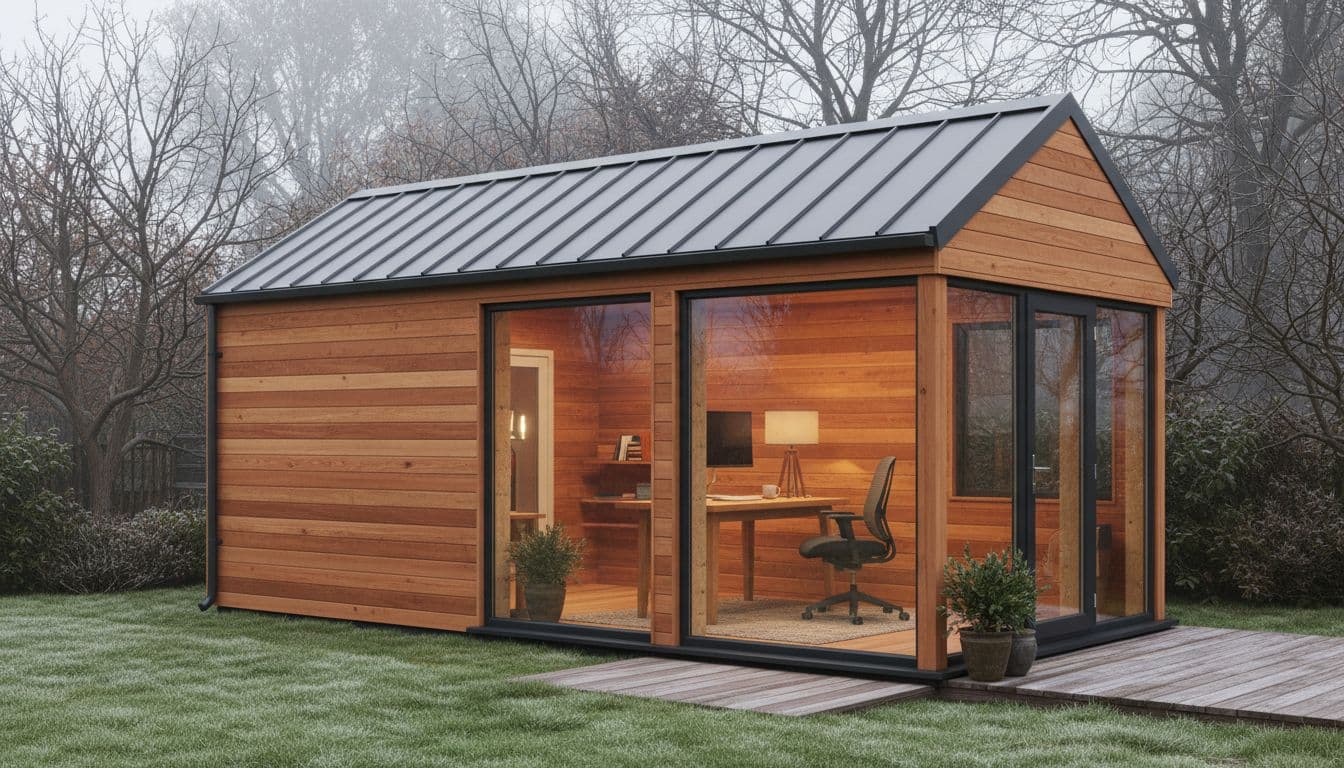 An insulated garden office designed for winter comfort, created with AI.
An insulated garden office isn’t only about warmth. It’s about making a small building behave like a real room: stable temperature, controlled moisture, fewer draughts, and a calmer place to work.
When the space holds heat properly, you can use a smaller heater for less time. Insulation also works in reverse, slowing heat getting in during summer, which matters more than ever in UK heatwaves. Add decent glazing and ventilation and you get a workspace that feels predictable, not one that changes mood with the forecast.
There’s also the day-to-day benefit: a quieter spot for calls, less household distraction, and a clearer end to the working day when you shut the door. For many homes, a well-finished garden office can also make the property more appealing, even if the exact value uplift varies by area.
Comfort all year, not just in summer
A basic summerhouse can feel lovely in July, then turn into a fridge by October. The biggest difference is the “building envelope”, meaning insulated walls, roof, and floor, plus airtight joins.
Common problems in non-insulated huts are easy to spot once you’ve worked in one for a week:
- Cold air sneaks in around doors and window frames.
- Floors feel icy, even if the air warms up.
- The roof radiates cold downwards, so you end up wearing a coat indoors.
A proper insulated garden office should feel closer to a small extension than a shed. That usually means an insulated floor (not just a deck), a roof build-up designed to hold heat, and wall insulation that fits tightly with minimal gaps. If you plan to work there daily, those details stop being “nice to have” and start being the reason the space gets used.
Lower running costs and a greener home office
Insulation reduces heat loss, so your heater doesn’t have to fight a constant uphill battle. That’s good for your wallet and your home’s energy use. It also makes temperature control less spiky, so the room feels steady rather than hot-then-cold.
To estimate heating costs, keep it simple and compare like-for-like:
Room size: Bigger rooms have more surface area to lose heat through.
Insulation level: Better-fitted insulation reduces drafts and cold spots.
Heater wattage: A 1,000 W heater uses 1 kWh per hour at full power.
Hours used: Think about your working week, not one cold day.
In a well-insulated pod, electric heating becomes more practical because you’re topping up warmth, not trying to create it from scratch. If you’re considering a small air-to-air heat pump, insulation helps even more, because heat pumps work best when the space holds temperature.
What to look for when comparing insulated garden offices
Buying a garden office is a bit like buying a winter coat. Style matters, but you’ll regret it if the zip leaks and the lining is thin. Compare specifications, not just photos.
Here’s what’s worth checking before you commit, especially if you’re comparing quotes that look similar on the surface:
- Structure and build quality: Thickness of framing, straight joins, solid fixings, and well-fitted internal lining.
- Insulation specs: What’s in the walls, roof, and floor, plus how it’s fitted.
- Weatherproofing: A breathable membrane behind cladding, proper flashing, and guttering.
- Glazing and doors: Double glazing, good seals, and secure locks.
- Ventilation: Trickle vents or planned airflow to reduce condensation.
- Electrics: Safe supply, enough sockets, and lighting you’ll actually enjoy using.
- Security: Lock quality, hinge protection, and window choices for privacy.
- Warranty and aftercare: Clear terms for structure, roof covering, and doors and windows.
If you see terms like insulated garden office panels, warm roof, double glazing, vapour barrier, and breathable membrane, that’s a sign the product is built with year-round use in mind. The detail still matters though, because the same words can hide very different build-ups.
Insulation and build specs that actually make a difference
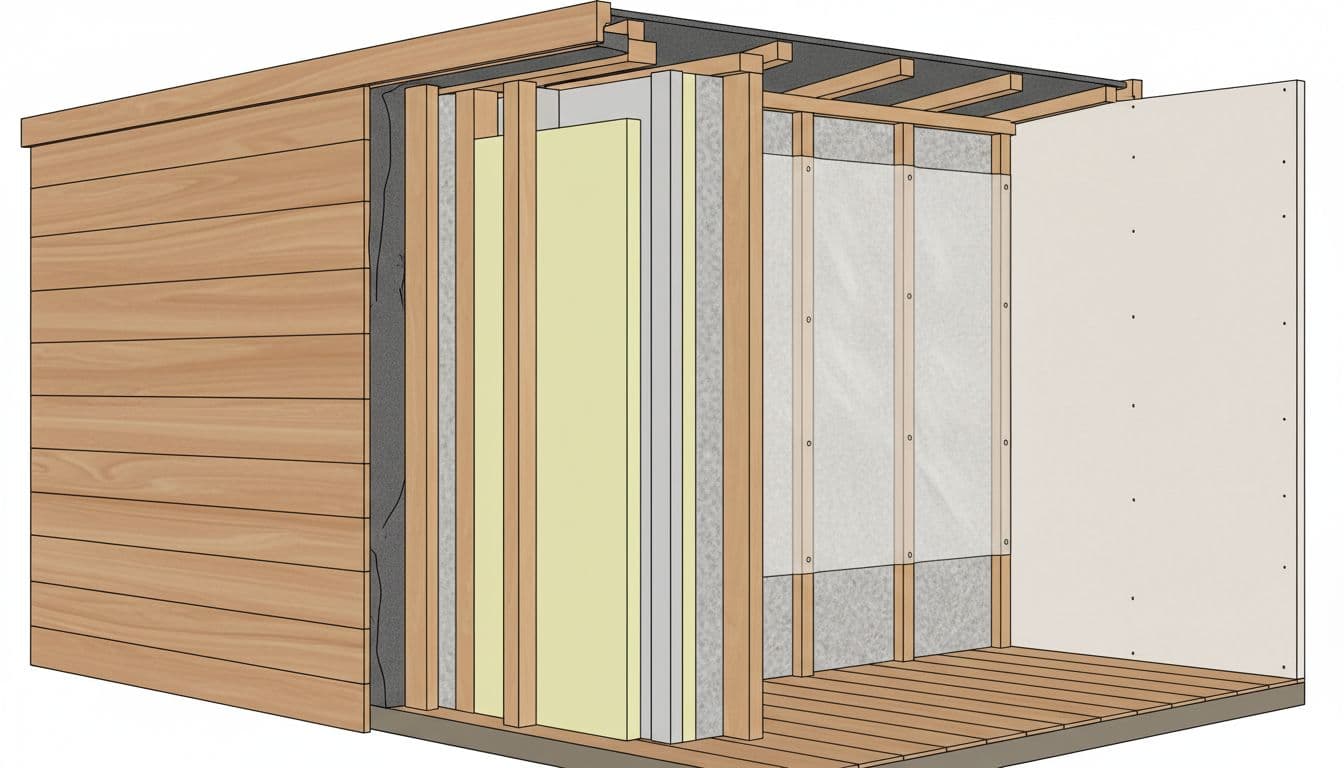 Typical layered construction for a warm, dry garden office wall, created with AI.
Most insulated garden offices use one of two insulation types, sometimes combined:
Mineral wool (glass or rock): Good for sound control, fills cavities well, but must be kept dry.
PIR boards: Rigid foam boards with strong thermal performance for their thickness, best when cut and fitted neatly.
Where insulation goes matters as much as what it is. For daily comfort, you want insulation in:
- Walls: Stops heat escaping and reduces cold wall surfaces.
- Roof: Often the biggest heat-loss area in small buildings.
- Floor: Reduces cold feet and makes the whole room feel warmer.
Thickness ranges vary by design, but as a practical guide, many year-round builds use something in the region of 50 mm to 100 mm insulation in key areas, sometimes more in roofs. Thicker isn’t automatically better if it’s badly fitted. Gaps, compressed mineral wool, and sloppy board cutting can leave cold stripes through the structure.
Two details that are easy to miss in brochures make a huge difference in real life:
Airtightness: Well-sealed joins around boards, corners, and service holes stop draughts.
Thermal bridging: Timber studs conduct heat more than insulation. Good designs reduce exposed bridges (for example, by adding a continuous insulated layer) so you don’t get cold lines on internal walls.
A vapour barrier on the warm side of insulation helps stop moist indoor air moving into colder layers where it can condense. Pair that with a breathable membrane on the outer side and the structure can resist rain while still allowing trapped moisture to escape outwards.
Windows, doors, and ventilation to prevent condensation
Condensation is what happens when warm, moist air hits a cold surface. In a small garden office, it can build up fast from breathing, hot drinks, and even drying a coat on the back of a chair.
Start with the obvious: double glazing is a baseline for year-round use. It keeps internal glass warmer, which lowers the chance of water droplets forming. A well-made door with proper compression seals also stops cold air leaking in around the edges.
Ventilation is the other half of the equation. You don’t want a draught, you want controlled airflow:
- Trickle vents help background ventilation without flinging the room temperature around.
- Passive vents can work if placed sensibly, not hidden behind furniture.
- Small extractor fans are useful in compact offices where humidity rises quickly.
If the room still struggles in wet months, a dehumidifier can be a good back-up, especially if you don’t heat the space every day. Also leave a small gap between large furniture and outside walls so air can move, which reduces cold corners and mould risk.
Foundations and weatherproofing for wet, windy gardens
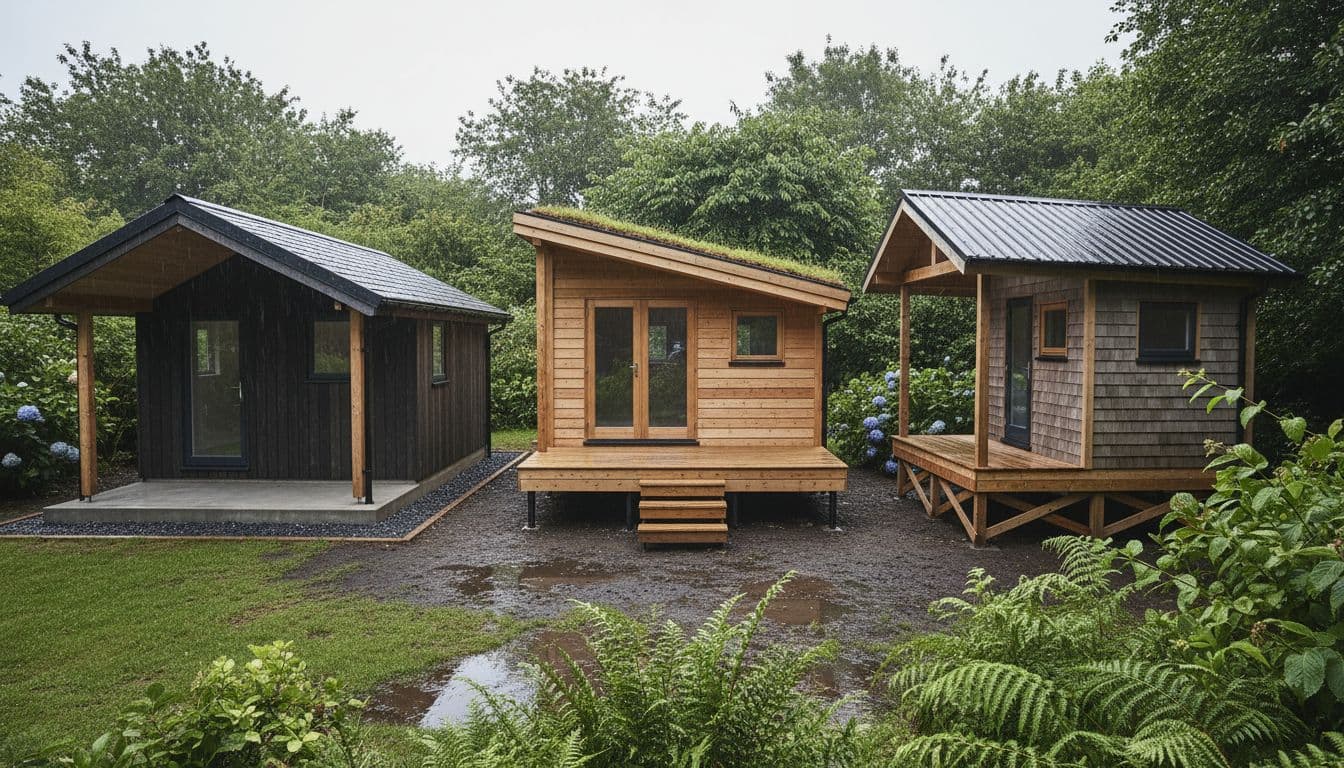 Common base types for garden offices, shown side-by-side, created with AI.
The base is easy to overlook because it’s not the exciting part, but it affects everything above it. A level, stable foundation helps doors and windows stay aligned, reduces movement in storms, and keeps moisture away from the floor.
Common UK options include:
Concrete slab: Very solid and long-lasting. Great for heavier buildings and soft ground. It can cost more and needs ground prep.
Ground screws: Faster install with less digging. Useful on sloped or awkward sites. It still needs careful setting out to stay level.
Timber base: Can work well when raised and ventilated correctly, often with a damp-proof layer and good airflow. It needs quality materials and proper support points.
Weatherproofing is about more than the outer cladding. Look for a system that manages wind-driven rain:
- A breathable membrane behind the cladding to stop water getting to the frame.
- Sensible roof details (overhangs help protect walls and openings).
- Gutters and downpipes that move water away from the base, not onto it.
- Clean finishing around windows and doors so water can’t track in.
Cladding choices are mostly about look and upkeep. Timber can look brilliant and weather naturally, but it may need treatment depending on the species and finish. Composite and metal can reduce ongoing maintenance, but you still need good detailing behind it, because the membrane and fixings do the real work.
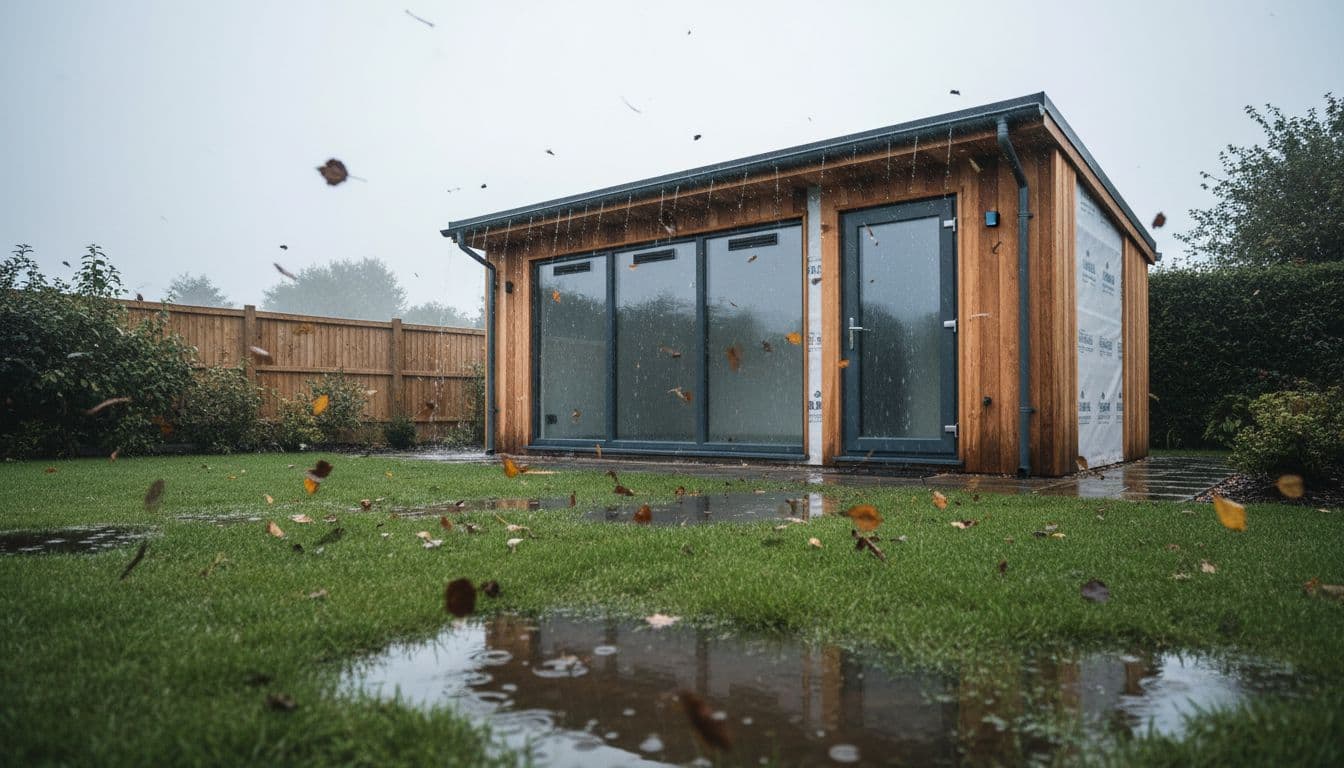 Weatherproof features that matter in a wet UK winter, created with AI.
Electrics, heating, and internet: plan it before you buy
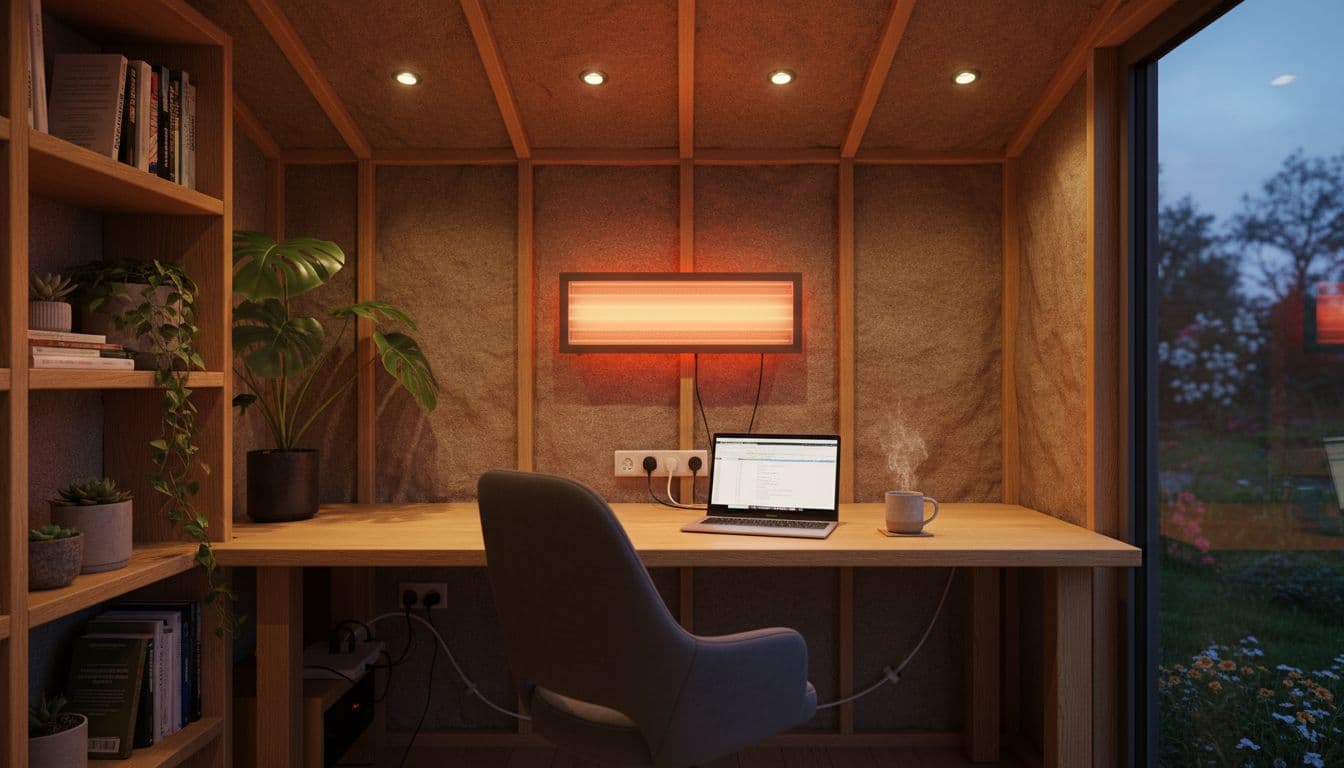 A practical garden office interior with heating, lighting, and connectivity, created with AI.
Electrics are much easier (and often cheaper) when planned early. Decide how you’ll use the room, then work backwards.
For a typical workday, think about:
Power supply: A professional installation is the safe route. Ask about RCD protection, cable routing, and whether the consumer unit has capacity.
Sockets: It’s rarely possible to have too many. Desk area, printer, heater, and a spare for charging.
Lighting: LED downlights or a mix of ceiling and task lighting reduces eye strain on dark afternoons.
Data: Wi‑Fi can be fine, but garden walls and distance can weaken it. Ethernet is more stable for calls, large uploads, and gaming after work.
Heating choices depend on how often you use the office and how insulated it is:
- Panel heater: Quick warmth, simple, wall-mounted options save space.
- Oil-filled radiator: Slower to heat, but holds warmth and feels gentle.
- Infrared heater: Heats people and surfaces more directly, handy for spot heating.
- Small heat pump: Efficient for regular use, but needs careful siting and installation.
Whatever you choose, insulation is what stops you paying to heat the garden.
Cost, planning rules, and setup tips for a garden office that lasts
This is where people often get caught out. The headline price might look attractive, then you add the base, electrics, better glazing, and interior finish. It’s not a problem if you plan for it, but it’s frustrating if it arrives as a surprise.
How much does an insulated garden office cost in the UK?
Costs vary by size, spec, access to the garden, and whether it’s supplied as a kit or fully installed. As a rough guide for late 2025, many insulated garden offices land somewhere between the high four figures and the tens of thousands once you include the basics.
What pushes price up fastest:
- Size (bigger footprint, higher roof, more materials)
- Insulation level (especially roof and floor build-ups)
- Glazing (more glass, larger openings, better frames)
- Interior finish (plasterboard and paint versus simple lining)
- Electrics (distance from house, trenching, number of sockets)
- Base and groundworks (slopes, drainage, poor ground)
- Delivery and assembly (tight access, cranes, parking limits)
A simple way to think about budgets is “good, better, best” based on how you’ll use it:
| Budget level | Best for | What you’ll usually prioritise |
|---|---|---|
| Good | Occasional work and hobbies | Basic insulation, modest glazing, simple electrics |
| Better | Regular weekday working | Strong wall, roof, and floor insulation, double glazing, planned ventilation, more sockets |
| Best | Full-time use year-round | High-grade insulation and airtightness, upgraded doors and windows, premium interior finish, heat pump option, enhanced security |
When comparing quotes, ask for a like-for-like breakdown. If one includes the base and electrics and the other doesn’t, they’re not competing on the same pitch.
Do you need planning permission or building regulations?
Many garden offices fall under permitted development in England, but details matter. Height, location, and how you use it can change everything.
In simple terms, permitted development often depends on:
- Use: An outbuilding is usually fine for a home office, gym, or hobby room. Using it as a sleeping space can trigger different rules.
- Height and roof shape: Limits apply, especially near boundaries.
- Location: Rules tighten at the front of the house and in some protected areas.
- Listed buildings and some conservation areas: Extra restrictions can apply.
Building regulations are a separate question. A basic garden office used as an ancillary space may not need full building control sign-off, but additions like plumbing for a bathroom, complex electrics, or sleeping use can change expectations. Electrical work should still be done safely and in line with UK rules. Always check your property details and confirm with your local council early, because it’s far easier than fixing a problem later.
Conclusion
A good insulated garden office is built like a small room, not a pretty shed. Focus on proper insulation in the walls, roof, and floor, combine it with double glazing and planned ventilation, and don’t skimp on the base. Sort electrics and internet on paper before anyone starts digging.
Next step: measure your garden space, write a short list of must-haves, then compare specs like-for-like (especially the vapour barrier, roof build-up, and floor insulation). Price up installation and realistic running costs, then choose the option you’ll still enjoy using next winter.

Explore More Expert Buyers Guides and Reviews
For a list of our main buyers guides use the drop-down menu at the top of the page. Topics related to this article are:
Home and Garden Furniture Buyers Guides
Bedroom Furniture Buyers Guides
living Room Furniture Buyers Guides
Garden Furniture Buyers Guides
–
Explore Our Blog Categories for Expert Buying Advice
- AI Powered Product Finder Tools (25)
- Expert Buying Guides & Shopping Tips for UK Shoppers (1,459)
- Brands & Designer Products (Men, Women & Electronics) (293)
- Designer Fashion Brands: Buyer’s Guides & Reviews (166)
- Electronic Brands: Buyers Guides & Reviews (92)
- Apple Products Buyer’s Guides & Reviews (25)
- Brands – Phones, Laptops, PC”s, Tablets | Buyer’s Guides & Reviews (44)
- Electronics – Tablet & iPad Reviews and Buyers Guides (10)
- Kitchen Appliance Brands: Buyer’s Guides & Reviews (24)
- Laptop Brands & MacBooks Buyer’s Guides & Reviews (9)
- Phone Brands & iPhones Buyer’s Guides & Reviews (23)
- Car Buying & Financing Made Easy | Expert Guides for the UK (89)
- Clothing, Fashion & Accessories Buying Guides UK (509)
- Beauty, Health & Wellness | Perfume, Skincare, Makeup & Wellbeing Guides (187)
- Footwear: Trainers & Shoes Buyers Guides (49)
- Jewellery: Expert Reviews, Trends & Buying Guides (74)
- Men's Clothes — Buyers Guides & Reviews (39)
- Men’s Clothes, Fashion & Accessories Guides UK | Latest Trends & Smart Shopping (172)
- Women's Clothing Buyers Guides — Dresses, Tops & More (201)
- Women’s Clothes, Fashion & Accessories Guides UK | Latest Trends & Smart Shopping (448)
- Electronics, Tech & Gadgets: Reviews, Deals & Buying Guides UK (182)
- Furniture Buyer’s Guides | Home & Garden & Styling Tips (329)
- Bedroom Furniture Guides UK | Expert Tips & Best Value Deals (93)
- Garden Furniture, Landscaping & Garden Rooms Guides UK | Expert Tips & Best Value Deals (170)
- Garden Sofa & Sofa Sets Buyers Guides (11)
- Garden Tables & Chairs: Sets, Individual Tables & Seating Buyers Guides (57)
- Home Furniture, Décor & Interior Design Guides UK | Styling Tips & Inspiration (170)
- Living Room Furniture, Design & Décor Guides UK | Styling Tips & Inspiration (57)
- Sofa & Sofa Beds Buyers Guides (19)
- Sofa Beds Buyers Guides (7)
- Sofa Buyers Guides & Expert Advice (11)
- Holidays & Travel: Hotels, Villas & Flights (162)
- Home & Garden Improvements | Renovations & Outdoor Transformation Guides (106)
- Insurance & Protection: Travel, Landlord, Gadget & More UK (159)
- Gadget Insurance UK | Expert Guides, Reviews & Smart Protection Tips (33)
- Home Emergency Cover UK | Expert Guides, Reviews & Practical Protection Tips (21)
- Landlords Insurance UK | Expert Guides, Reviews & Smart Protection Tips (31)
- Travel Insurance UK | Expert Guides, Reviews & Money-Saving Tips (34)
- Pets: Guides, Tips & Inspiration (28)
- Brands & Designer Products (Men, Women & Electronics) (293)
- Gifts for Everyone: Ideas for Every Occasion & Budget (51)